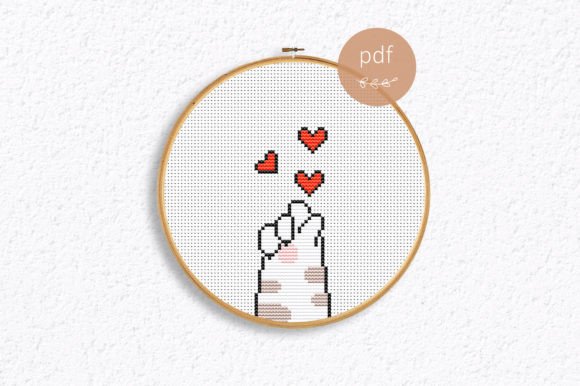
Valentines Day Cross Stitch Pattern PDF
First Impression: Sweet, Compact & Craft-Fair Ready
As an embroidery designer who’s prepped over 200 craft fair booths—from Portland bazaars to Nashville maker markets—I opened the Valentines Day Cross Stitch Pattern PDF expecting charm, not clutter. What landed was exactly that: a clean, focused cat motif with clear Valentine’s energy—playful but not saccharine, minimalist but not sterile. At just 1.64 × 4.29 inches (23 × 60 stitches on 14-count Aida), it reads as *intentional*, not scaled-down. It’s neither rustic nor ultra-modern—it lands in that sweet spot of “handmade premium”: soft enough for tea towels, bold enough for tote bags, and detailed enough to feel special without demanding perfection.
Where This Design Shines On Craft Fair Products
This isn’t a wall-hanging pattern—it’s a *product engine*. Here’s where the Valentines Day Cross Stitch Pattern PDF delivers real booth ROI:
- Tote bags: Centered on a natural canvas or linen tote, it pops without overwhelming. The narrow vertical format fits perfectly above the seam—no awkward cropping or lost detail.
- Aprons: Positioned just below the pocket or on the bib, it adds personality without competing with functional space. Five DMC colors keep thread inventory lean for batch production.
- Tea towel embroidery: Works beautifully on medium-texture cotton towels. The stitch count is low enough to avoid stiffness, yet dense enough to hold shape after repeated washing.
- Embroidered patches: At this size, it translates cleanly to iron-on or sew-on patches—ideal for Etsy sellers bundling “Valentine’s Mini Kits” or boutique makers adding branded accents to denim jackets.
- Fabric pouches & pillow covers: Fits snugly on 5×7-inch front panels. No stretching, no distortion—just consistent, repeatable charm.
What Makes It Sell—And What Requires Caution
The Valentines Day Cross Stitch Pattern PDF wins at craft fairs because it’s *instantly legible*. Customers glance and think: “Cat. Hearts. Handmade. Valentine’s.” That clarity drives impulse buys—especially when stitched onto a ready-to-gift item like a small drawstring pouch or linen sachet.
But here’s where experience kicks in: this design thrives at its native scale. Shrinking it below 1.5 inches risks losing definition in the cat’s facial features and heart outlines. Likewise, avoid placing it on heavily textured fabrics (like bouclé or thick terry cloth) or curved surfaces (like structured caps)—the 23×60 stitch grid needs stable, flat real estate.
Also note: while five thread colors are manageable, check contrast carefully on dark fabric. DMC 310 (light tan) or 743 (medium gray) may fade into navy or charcoal unless backed with stabilizer. Always test on scrap first—especially if you’re planning commercial embroidery or machine-embroidered versions.
Photography, Listings & Digital Appeal
This pattern photographs exceptionally well for Etsy listings and social previews. Its compact size means you can show multiple product mockups in one flat-lay: a stitched tea towel beside a pouch, an apron cuff detail, a framed mini sampler. That versatility boosts perceived value—and encourages add-on sales (“Get the pattern + finished patch bundle”).
For printable mockups, the clean lines and limited palette render crisply at 300 DPI. As a digital embroidery file alternative, it’s easy to convert—but remember: cross stitch and machine embroidery demand different spacing, underlay, and density logic. Don’t assume the PDF translates directly to a .pes or .dst file without redesign.
Production Practicality: Speed, Consistency & Scalability
If you’re stitching 20+ items for a weekend fair, the Valentines Day Cross Stitch Pattern PDF is a dream. With only 23×60 stitches, each piece takes ~45–90 minutes depending on skill level—fast enough for batch work, slow enough to maintain handmade integrity. The 5-color limit means fewer thread changes, less waste, and easier kit assembly.
Hoop size? A 4-inch hoop handles it comfortably—no need for oversized frames that eat into table space. And because the design area stays within 5–6 inches total (as recommended), framing is simple and shelf-ready.
Designer Notes You Can’t Skip
Before cutting your first fabric swatch, do these six things:
- Test on scrap fabric—same weight and weave as your final product (e.g., unbleached linen for tea towels, medium-weight cotton for pouches).
- Check thread contrast against your base fabric under both daylight and warm booth lighting.
- Review spacing between key elements—especially around hearts and cat ears—to ensure clarity at scale.
- Confirm hoop compatibility and whether your chosen stabilizer (tear-away vs. cut-away) supports the fabric texture.
- Create one real mockup—not just digital—so you can assess drape, stitch tension, and perceived quality in person.
- Verify commercial licensing before selling finished products. This Valentines Day Cross Stitch Pattern PDF is marketed as a Graphics-type digital file—confirm usage rights for physical resale if you’re not the original designer.
Final Verdict: A Quiet Standout for Thoughtful Makers
In a sea of oversized florals and glittery fonts, the Valentines Day Cross Stitch Pattern PDF stands out by being *restrained*. It doesn’t shout—it invites. It works equally well as a subtle accent on a market bag or a charming focal point on a gift pouch. For Etsy sellers juggling SEO and shelf appeal, it’s keyword-friendly (“cat cross stitch,” “Valentine’s pattern,” “small cross stitch”) without sacrificing aesthetic cohesion.
It won’t dominate your booth—but it will linger in customers’ minds as the piece they *almost missed*, then circled back for. That’s the hallmark of a strong craft fair product: not the loudest, but the most quietly confident. And for handmade shop owners building brand consistency across seasons, this pattern slots seamlessly into a curated collection—no rebranding, no tone shift, just quiet, stitch-perfect intention.
Whether you’re sourcing Cross Stitch Patterns for digital resale or hand-stitching finished goods, treat the Valentines Day Cross Stitch Pattern PDF as what it is: a small, smart, scalable asset—designed not just to be made, but to be *chosen*.